Printer troubleshooting

Why does my printer say offline?

A plain-language checklist for an offline printer, including power, Wi-Fi, the print queue, and when the problem may be mechanical.

Prepared and reviewed by South Bay Tech Rescue
Published | Updated

Share, copy, or print this guide.

Several common issues can cause an offline status. The printer may be asleep, connected to a different Wi-Fi network, paused by a stuck print job, or selected incorrectly on the computer.
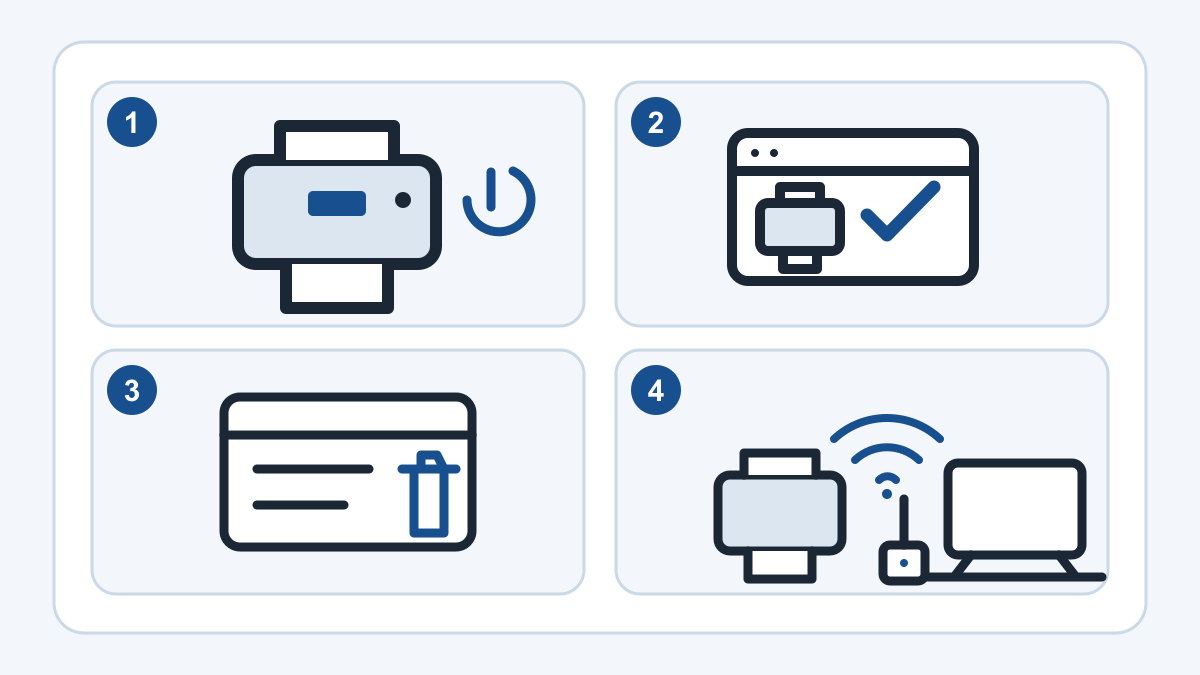
Four numbered panels show the printer display, selected printer, print queue, and a shared Wi-Fi connection.
Check in this order: read the printer screen, confirm the selected printer, clear only jobs you recognize, and make sure the printer and computer use the same Wi-Fi.

What "printer offline" means

Printer offline means the computer, phone, or tablet cannot communicate with the printer at that moment. It does not necessarily mean the printer is broken.

Check the printer before changing settings

Make sure the printer is on and its screen does not show a paper, ink, toner, cover, or jam message. Confirm that paper is loaded and that every tray and door is fully closed.

If the printer is connected by a cable, check both ends. If it uses Wi-Fi, look for a wireless symbol or connection message on the printer's screen.

  • Wake the printer with its power or home button
  • Read the entire message on the printer display
  • Check paper, ink or toner, doors, and removable trays
  • Avoid pulling hard on jammed paper or small internal parts

Make sure you are sending the job to the right printer

A computer may remember an old printer, a duplicate copy, or a save-to-file option. Open the print window and read the selected printer name before sending another test page.

If more than one similar printer name appears, stop adding new copies. Duplicates can make the choice less clear and may need to be cleaned up in the computer's printer settings.

Look for a stuck or paused print job

A failed document can hold the rest of the queue. Open the printer queue and look for an item marked paused, error, or deleting. Cancel only the jobs you recognize, then wait for the queue to clear before trying one small test page.

Restarting the printer and computer can re-establish a connection, but repeated restarts will not solve a wrong Wi-Fi network, damaged cable, or mechanical problem.

Check the Wi-Fi connection

The computer and printer normally need to be on the same usable network. A new router, changed Wi-Fi name, changed password, guest network, or range extender can leave the printer on an old or isolated connection.

If every device has trouble getting online, begin with the network rather than the printer. If only the printer is affected, its saved Wi-Fi settings or computer setup may need attention.

Questions about this problem

Use these answers as a starting point, not a diagnosis.

What does printer offline mean?
It means the device sending the print job cannot communicate with the printer at that moment. Power, Wi-Fi, a cable, the selected printer, or the print queue may be the cause.
Why can my phone print when my computer cannot?
That suggests the printer is reachable from at least one device. The computer may have the wrong printer selected, a stuck queue, outdated setup software, or a different network connection.
Will removing and adding the printer fix it?
Sometimes, but first confirm the printer is on, free of errors, and connected to the correct network. Removing a printer too early can erase a useful working setup and create duplicate entries when it is added again.
Can an old printer work with a new computer?
It depends on whether the printer maker supports the computer's operating system and connection method. The model number helps determine what setup software or alternatives are available.

Still seeing an offline printer?

Call with the printer model, the device you print from, and whether anything changed with the Wi-Fi or computer before the problem began.

How can we reach you?

Add a phone number, email, or both.

This helps us check whether we serve your area.

Name your device and the problem. A few words are enough.

For your safety, do not send passwords, security codes, banking or medical information, Social Security numbers, or remote-access codes.

You stay in control. You approve changes and enter passwords yourself.

This asks us to contact you. It does not schedule a visit.

We use your details only to reply and manage this request. They are not sold or added to an advertising list. See our privacy notice.